Production and Operational Use
It was first fitted to the Caudron G.3 aircraft equipped with an 80 hp Clerget engine. This was a good start, all the more so because the Battle of Verdun, raging since February 1916, led to additional orders for aircraft—and therefore for propellers. Marcel Bloch was then assigned to Hirch Minckès’ workshop:
“As I was starting to have too much work, I suggested to Potez that he come work with me. He left the Caudron design office without regret.”
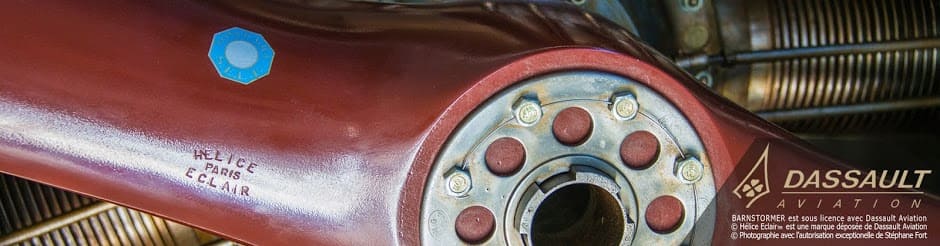
Because production needed to ramp up quickly, Marcel Bloch suggested that Hirch Minckès create a company. Minckès sought advice from several friends, including E. Dumaine, general manager of the Société des moteurs Clerget, who encouraged him to do so. Hirch Minckès and his associate, Edeline, founded the Société des Hélices Éclair, with Marcel Bloch and Henry Potez as technical directors, to whom the army assigned them.
Several carpenters joined their team, while the Clerget company supported their venture by ordering brake-propellers for its test benches. Their business grew, occupying an entire floor of the furniture workshop on Avenue Parmentier, where they formed a separate section. The two friends subcontracted externally the parts requiring machining:
“We had the blades cut outside, we glued them together at his place, and then they had to be shaped. All the furniture makers of the Faubourg Saint-Antoine had started building Éclair propellers.”
Their partnership was a success. The Éclair propellers equipped the British Sopwith reconnaissance aircraft built under license in France, the Dorand AR, and especially the Spads—most notably the Spad VII of the most famous French ace, Georges Guynemer, dear to Marcel Bloch’s heart:
“When Guynemer’s aircraft, Le Vieux Charles, with its nineteen victories, was displayed at the Invalides as a witness to glory, I went to see it, and upon arriving I naturally looked at the propeller. And it was a propeller that I had designed and built. I felt great satisfaction, and perhaps a bit of pride.”
In 1917, success came for the two second lieutenants, whose company in just a few months became one of the four major propeller manufacturers, at a time when no fewer than forty manufacturers and 253 different designs existed. The Materiel Inspection Service decided to keep only three propeller series at most for any given aircraft. Among them was the Éclair propeller. In this way, Marcel Bloch and Henry Potez entered the legend of aviation.








 Fly safe !



 Garanties sécurité
 Politique de livraison
 Politique retours